Guides
-
How does journey mapping improve UX?
Journey mapping for better website user experience
Learn how journey mapping uncovers friction, aligns teams, and improves the website user experience through clearer, more considered design.
Three key methods used in this
guide
User research
Interaction & flow design
Prototyping
Understanding where people get lost online
Most websites are designed from the inside out. Teams build pages around what the organisation wants to say, not around what a person is trying to do when they arrive. The result is a website that makes sense to the people who built it and no one else.
This is one of the most persistent problems in digital design. A user lands on a page looking for a straightforward answer. Instead, they encounter unclear labels, buried information, or a task flow that requires them to guess what comes next. They either push through with frustration or leave.
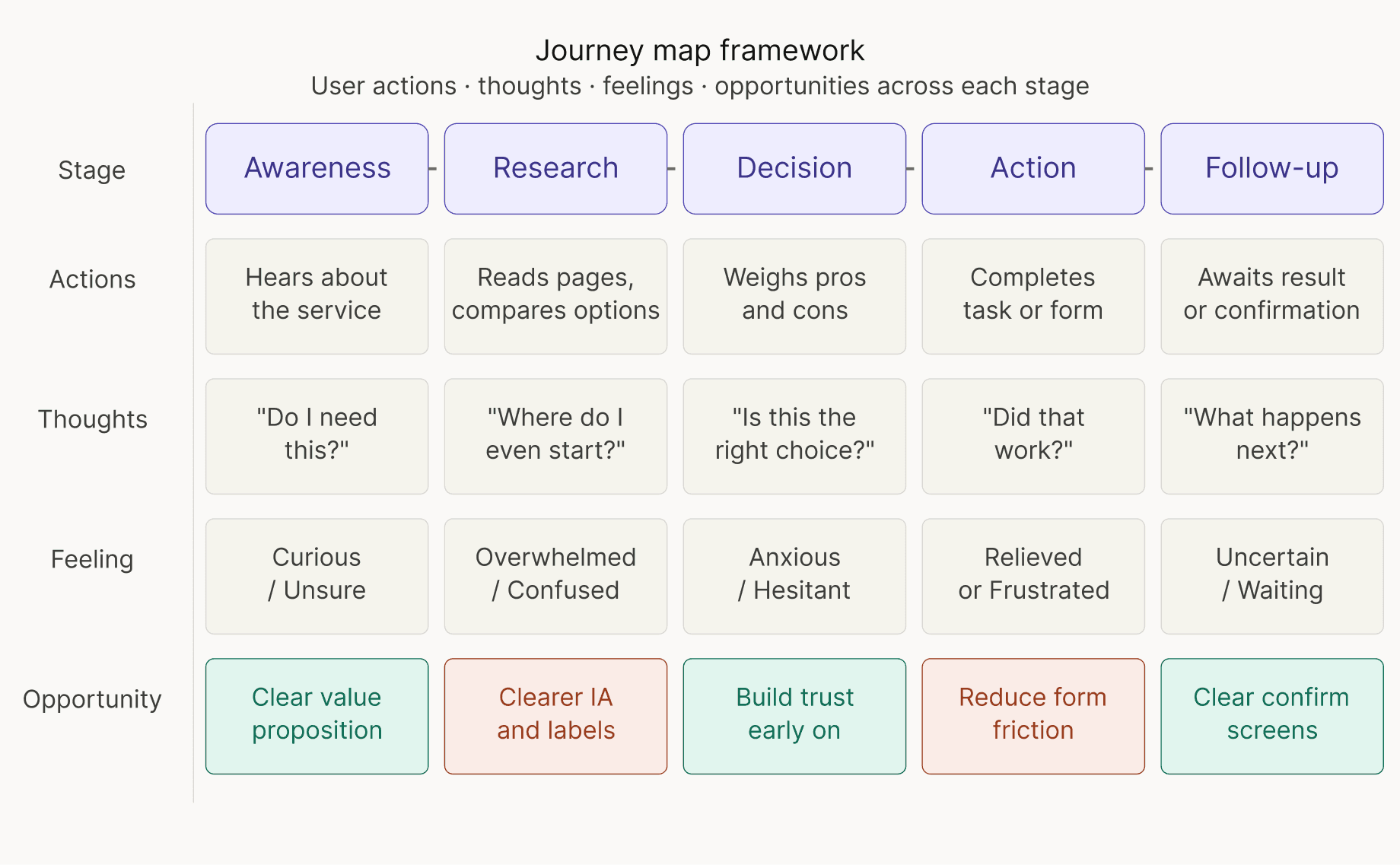
Journey mapping was developed to address exactly this kind of disconnect. It is a structured method for stepping into a user's shoes and tracing the full arc of their experience, what they are thinking, what they are feeling, where they hesitate, and where they give up entirely.
Unlike analytics, which can tell you that someone dropped off at a particular point, a journey map tells you why. It captures the emotional and cognitive context behind user behaviour, which makes it far more useful as a design tool.
What happens when the user's experience is never mapped
When design work begins without a journey map, the team is essentially guessing. They might have personas, analytics data, or stakeholder input, all useful, but without mapping the actual sequence of steps a person takes, critical gaps in the experience tend to stay hidden until after launch.
Hidden friction points go undetected
Customer journey maps are particularly effective at surfacing friction that internal teams have become blind to. When you work closely with a product or website, you stop noticing the things that confuse first-time users. Journey mapping forces that fresh perspective back into the process.
A common example: a multi-step form that seems logical to the team that built it, but creates confusion for users who do not share that mental model. Without mapping the experience step by step, the friction points remain invisible until usability testing reveals them, often late in the process, when changes are expensive.
Emotional moments are overlooked
Much of what drives user behaviour is not rational. It is emotional. A person applying for a council service, submitting a support request, or navigating a government portal is often already stressed before they begin. If the interface adds to that stress, they disengage.
Journey maps that include an emotional layer, tracking how a person feels at each stage, not just what they are doing, give design teams a much richer picture. They reveal the moments that matter most, where a small improvement in clarity or reassurance can have a disproportionate impact on the overall experience.
The peak-end rule and why it matters
Research in behavioural psychology consistently shows that people judge an experience not on its average, but on its most intense moment and how it ends. This is known as the peak-end rule. For web experiences, this means a frustrating mid-flow interaction or an unclear confirmation at the end can define how someone feels about the entire experience, regardless of how smooth the rest was.
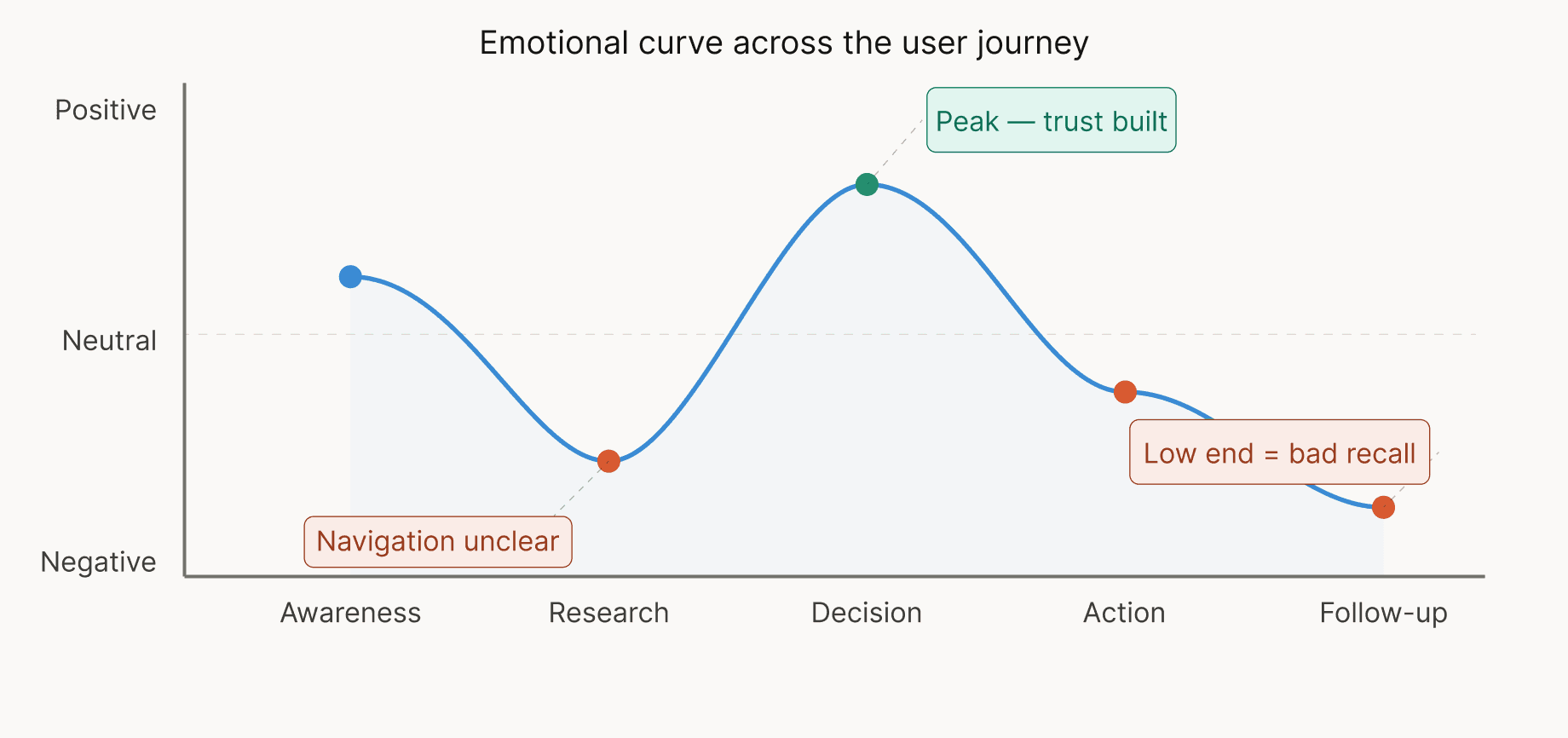
Without a journey map, teams rarely account for this. They optimise individual screens in isolation rather than thinking about the shape of the full experience.
Teams working from different assumptions
One of the less obvious costs of skipping journey mapping is internal misalignment. Designers, developers, content writers, and product owners often hold different assumptions about what users are doing and what success looks like. These assumptions are rarely made explicit, which means they quietly shape decisions in conflicting directions.
This is how you end up with a website where the navigation was designed for one mental model, the content was written for another, and the call to action was placed based on a third assumption that no one tested.
How journey mapping creates clarity, alignment, and better outcomes
Journey mapping works because it makes the user's experience concrete and shared. It turns assumptions into evidence, and individual perspectives into a single, agreed-upon picture of what is actually happening.
Creating a shared team language
One of the most immediate benefits of journey mapping is its impact on team communication. When everyone, designers, developers, stakeholders, and content writers, is looking at the same map, they stop debating whose interpretation of the user is correct and start solving the same problem.
This shared language is particularly valuable in cross-functional teams or projects involving multiple agencies or departments. A journey map becomes the reference point that keeps decisions grounded in user reality rather than internal politics or personal preference.
Uncovering what to fix first
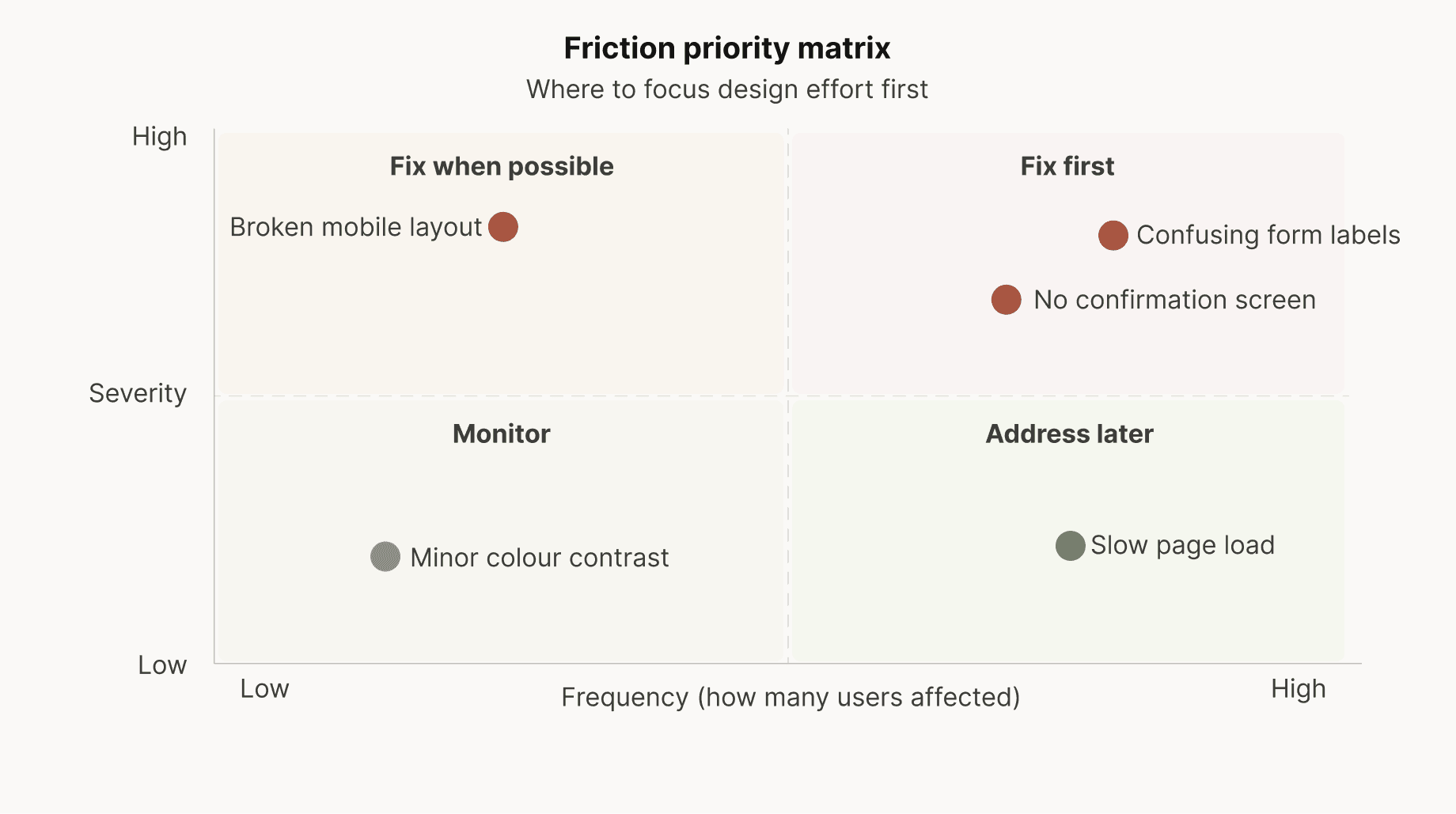
Not every friction point is worth addressing immediately. Journey mapping helps teams prioritise by making the severity and frequency of problems visible. A moment of confusion that affects every user on a critical task path is a higher priority than a minor inconsistency on an edge-case screen.
Enabling cross-functional alignment
Journey maps are not just design tools. They are communication tools. When shared with leadership, product teams, or client stakeholders, they translate the complexity of user experience into something accessible and persuasive. They build the business case for investment in design improvements by connecting user pain points to measurable outcomes, such as drop-off rates, support call volumes, and task completion rates.
For public sector and not-for-profit organisations in particular, where resources are limited, and every design decision needs justification, this kind of evidence-based alignment is essential. If you are working on a project where stakeholders need convincing before design work can begin, journey mapping provides the foundation, as it is closely connected to the broader discipline of product discovery: understanding the problem deeply before committing to a solution.
Journey maps work best when treated as living documents, revisited after design changes to assess whether friction has been reduced and whether the overall experience has improved.
Choosing the right type of journey map
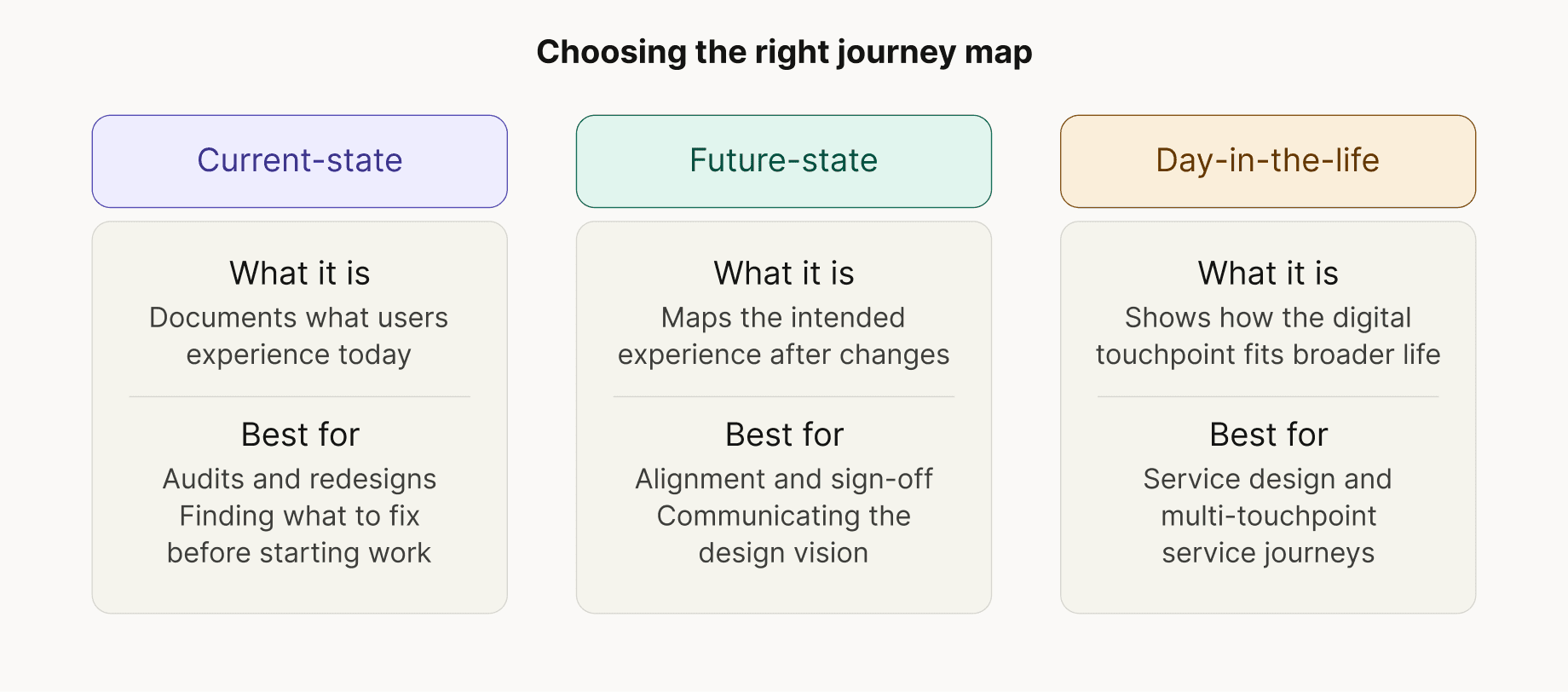
Different projects call for different types of maps. A current-state map documents what users experience today. A future-state map articulates the intended experience after changes are made. A day-in-the-life map zooms out to show how a digital interaction fits into a broader service context. Choosing the right type depends on where the project is in its lifecycle and what decisions the map needs to support.
Putting it into practice
Journey mapping does not require a large budget or a dedicated research team. It can be done lightly, through a workshop with key stakeholders, a small round of user interviews, and a collaborative mapping session or in depth over several weeks with extensive research and validation.
What matters is that it happens before major design decisions are locked in. The earlier in a project a team maps the user's experience, the more value the map delivers. Changes made at the strategy and structure stage cost a fraction of what they cost after build.
For teams asking how to improve their website without rebuilding it from scratch, journey mapping is often the most revealing place to start. It surfaces the specific moments when the experience breaks down, giving designers and stakeholders the clarity they need to fix the right things, in the right order.
You might find these helpful
A few related articles that build on what you’ve just read.